Abraham
Abraham did not walk out of nowhere into a covenant with the Godhead. He walked out of the Anunnaki's house.
Genesis 11:28 places his birth in Ur of the Chaldeans. Ur is Tell el-Mukayyar in modern Dhi Qar Province, southern Iraq. At the time of Abraham's life, estimated by most scholars at somewhere between 2000 and 1800 BC, Ur was one of the most sophisticated cities on earth. It was the city of Nanna, the moon god, one of the great Anunnaki. The Great Ziggurat of Ur, built during the Third Dynasty of Ur around 2100 BC, still stands partially in the Iraqi desert. Abraham grew up in the shadow of that ziggurat. He walked those streets. He lived inside the theological architecture of the Anunnaki for the first decades of his life.
Joshua 24:2 makes something explicit that is easy to pass over. Your ancestors, including Terah the father of Abraham and Nahor, lived beyond the Euphrates River and served other gods. Abraham's father Terah was a polytheist. Jewish tradition adds that Terah was an idol maker. When the God who would call himself Yahweh reached into Ur and called Abraham out of it, he was not calling him away from ignorance. He was calling him away from a system he knew intimately, a system whose gods were real and whose power was documented and whose demands he had lived under his entire life.
What he was being called toward is the central question.
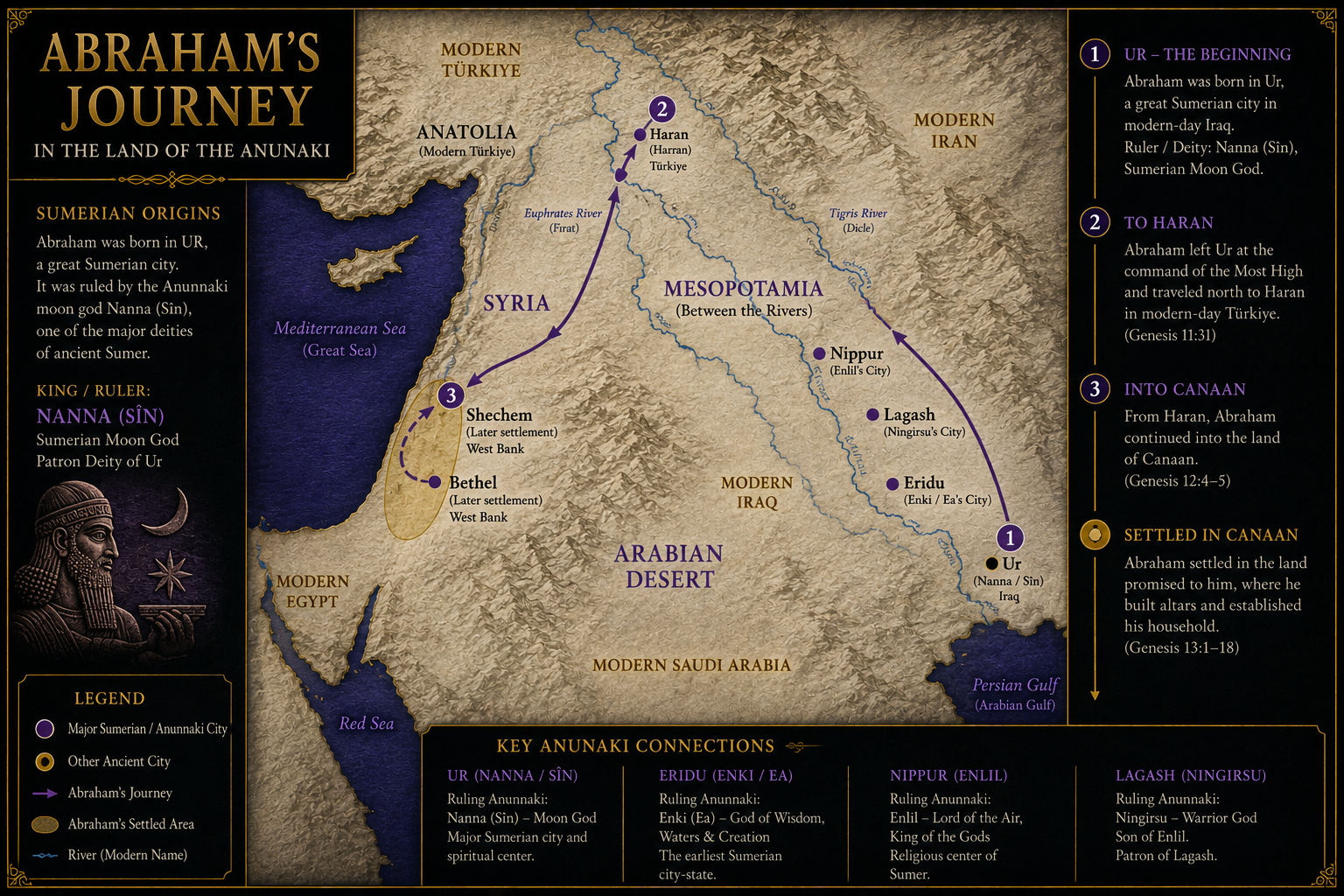
The Route
The family left Ur heading toward Canaan, the territory of modern Israel and Palestine. They stopped at Harran, a city in what is now Sanliurfa Province in southeastern Turkey. Harran was also a moon god city. The same Nanna, called Sin in Akkadian, was worshipped at Harran with the same fervor as at Ur. Either by coincidence or by design, the family's first stopping point after leaving the moon god's city was another moon god city. Terah died in Harran.
From Harran, Abraham received his call. Genesis 12:1. Go from your country and your kindred and your father's house to the land that I will show you. The voice did not specify where. It said go. The faith being demanded was directional before it was doctrinal. Move first. Understand later.
He traveled through Shechem, modern Nablus in the northern West Bank of Palestine, where a Canaanite deity named El had a shrine at a great tree called the Oak of Moreh. He traveled to Bethel, modern Beitin in the central West Bank, where he built an altar. He went down to Egypt when famine came, then returned. He settled eventually at Hebron, modern Al-Khalil in the southern West Bank, where he built another altar and where God confirmed the covenant with him. Hebron is where Abraham, Sarah, Isaac, Rebecca, Jacob, and Leah are believed to be buried, in the Cave of Machpelah beneath the Ibrahim Mosque, one of the most contested religious sites on earth.
El Elyon and Melchizedek
Genesis 14 contains a scene that most readers pass over quickly but which is theologically foundational for this archive. After Abraham's military victory over a coalition of kings, a figure named Melchizedek appears. He is king of Salem, the ancient name for Jerusalem. He is described as a priest of El Elyon, God Most High. He brings out bread and wine. He blesses Abraham in the name of El Elyon. Abraham gives him a tenth of everything he has recovered in battle.
Melchizedek appears from nowhere and returns to nowhere. He has no genealogy, which in a Biblical text that traces lineages obsessively is extraordinary. Psalm 110 declares the Davidic king a priest forever in the order of Melchizedek, reaching back to this figure as the model for the highest priestly office. The letter to the Hebrews in the New Testament spends several chapters on Melchizedek, calling him without father, without mother, without genealogy, having neither beginning of days nor end of life.
El Elyon is not a uniquely Israelite name for God. It is the Canaanite title for the head of the divine council, the highest of the divine beings. El, the ancient one, the father of years, who presided over the assembly of the gods in the Ugaritic texts found at Ras Shamra in modern northwestern Syria. When Abraham accepted Melchizedek's blessing in the name of El Elyon, he was accepting a theological framework that placed the being who had called him at the top of an existing divine hierarchy. The Godhead above the council. The Most High above the Anunnaki.
This is the theology of the archive. Anu, El, El Elyon, the Ancient of Days. One Godhead. The Anunnaki and the divine council are real beings subordinate to that Godhead. Abraham was called out of the household of one of those subordinate beings and into direct relationship with the one above them all. Whether the being who called him was the Godhead itself or one of the Anunnaki acting as intermediary and claiming to speak for the Godhead is a question the archive holds open and asks you to discern for yourself as you read further.
The Covenant Ceremony
Genesis 15 describes something strange. God tells Abraham to cut several animals in half and arrange the pieces opposite each other. A smoking firepot and a flaming torch pass between the pieces. And on that day the Lord made a covenant with Abraham.
This is not strange to anyone who knows the ancient Near Eastern legal world. It is a suzerainty treaty. A binding legal contract form used throughout Mesopotamia in exactly the period attributed to Abraham. Both parties would walk between the severed halves, invoking the fate of the animals upon themselves if they violated the covenant terms. In Genesis 15, Abraham is in a deep sleep. Only the divine presence passes between the pieces. Only one party takes the oath. The covenant is unconditional on Abraham's side because only the divine party swore it.
The being who called Abraham out of Ur spoke to him in the legal language of the world Abraham came from. It used the covenant forms Abraham would have recognized from the Mesopotamian legal culture he was raised in. It did not demand that Abraham comprehend a new theological framework before it could communicate with him. It used what Abraham already knew and reoriented it toward something new.
As above, so below. The divine communicates through the forms the human already possesses. This is either the condescension of the Godhead toward its creatures or the strategy of a being who knows exactly how to be heard.